Bread and Oil
Umbria is as ordinary, and extraordinary, as bread and oil. Let me tell you what I mean.

From the archives: Written during the 2020 olive harvest
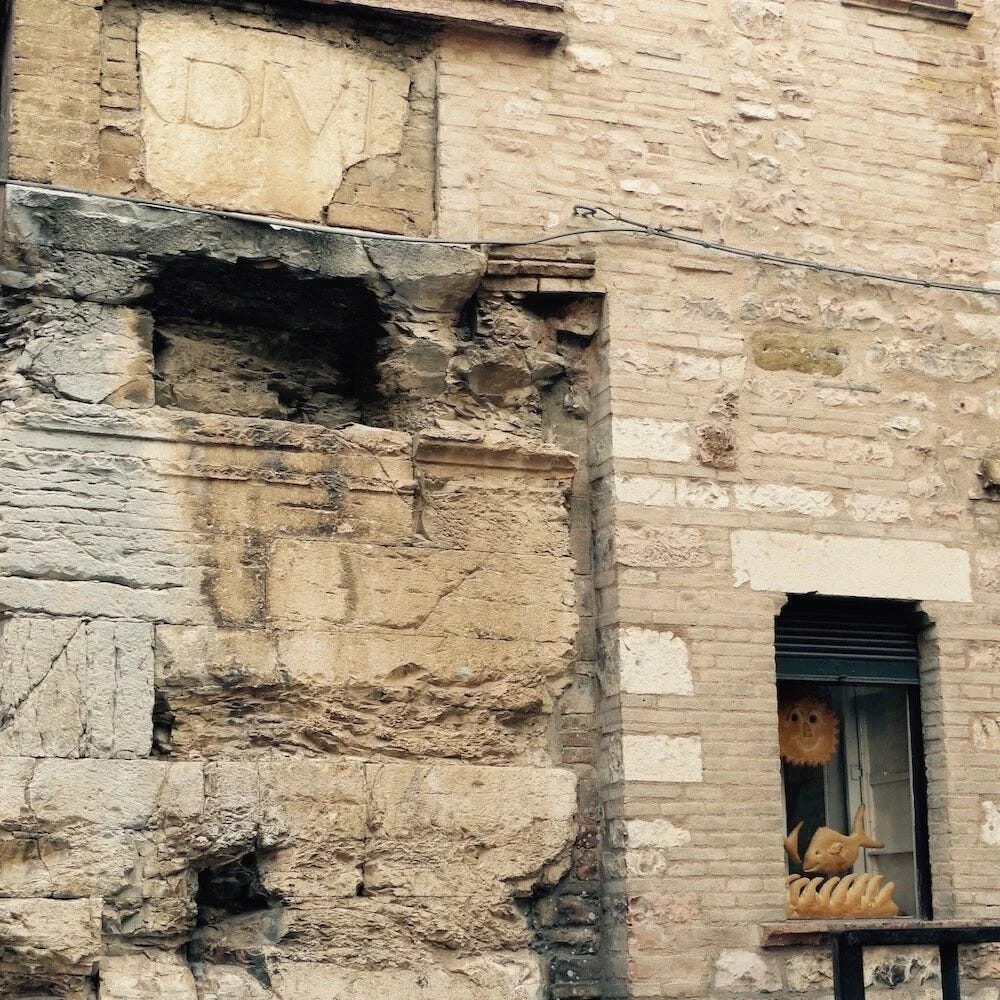
The comically-tiny street sweeper whirs up Via Giulia as I shift my weight, standing outside the forno. The customer in the bakery keeps up a running commentary, now leaning around the COVID-era plastic partition to gesture at Giovanna, who nods, carefully placing pastries in a bag. I can see she is in no rush to leave. This is Umbria, where a quick errand is as common as poorly cooked pasta (I’ve never seen either), and I know I might as well make myself comfortable.
Luckily, my cadence has adapted to Umbrian rhythms, and I consider the wait an opportunity to lift my nose and savor the bakery’s scent winding into the autumnal fog. I let my gaze trace the ancient Roman wall. That wall—the remains of the Arco di Augusto—might not be a big deal to people who grew up with remnants of ancient civilizations standing alongside stoplights, but my American-bred eyes never tire of admiring the forno nestled under huge stones etched with ancient script.
The customer finally runs out of gossip and adjusts her scarf before exiting. We nod to each other and I step forward to the worn wood and glass door. It sticks a bit, the glass panels steamed from the warmth within so that Giovanna, now rearranging the display case, has a sfumato glow.
Entering the forno, you’d be hard pressed to imagine a smaller shop. There’s hardly room to turn around. It’s funny to recall that before the pandemic limited the number of customers inside, you’d get three or four people crammed into that space, arguing about the weather and calling out to the men in their underwear and sneakers, baking loaf after loaf of unsalted Umbrian bread.
As tiny as it is, the offerings are never the same two days in a row. Yes, there’s always pizza, but sometimes zucchini flower pizza beside the standards of rosemary and tomato sauce. Or more often, onion—my favorite, those caramelized alliums bringing out the yeastiness of the dough. I love serving them with Umbrian lentil soup, or cubing them to enjoy with afternoon spritzes and a bowl of briny capers, harvested from the pink Subasio walls of Spello.
You can always find biscotti, but sometimes they are almond ones meant to be dipped into a sweet after-dinner liquor (Tuscany’s Vin Santo, or here in Umbria, Sagrantino Passito). Sometimes instead, cookies shaped like biscotti but softly yielding, folded around prune or apricot jam.
Get there early and you’ll find breakfast pastries, but there’s often a surprise alongside cornetti and donuts heavy with cream or Nutella. My eyes always light up when I spot the last treccia, a braided, walnut-filled pastry. My family will no doubt fight over it, but the earthy nuttiness that rounds out the caramelized sugar is worth it.
Beyond the routine forno offerings of bread, biscotti, pizza, and breakfast, the bakery almost always offers something different. Experimental biscotti, perhaps, or small cakes with pine nuts. Or a sandwich on crackling flatbread that took me ages to learn to say. Eventually, Giovanna wrote it down for me: scrocchiarella, reassuring me it’s a very hard word.
Holidays are an especial adventure. In December, they outdo themselves with pandoro even better than what I had in Venice (I swear I’m not biased), and a panettone so stretchy and layered I have to close my eyes at each bite. And don’t get me started on carnevale sweets—each day a new fritter or fried pastry, some common in Umbria, some, like snails of pastry flecked with orange peel, found only in Spello.
But currently it’s November, still a ways from holiday treats, and the wine-must bread ended with the vendemmia, so my eyes scan the glass case. I look up and meet Giovanna’s eyes.
“I maritozzi? Sono finiti?” I’m often too late for my favorite pastry, an unctuously soft bun filled with obscene amounts of whipped cream.
She shakes her head, leaning against the counter. “The harvest.” She gestures out toward the olive groves spilling from Spello like a patchwork apron. “Maritozzi need a long rise, and we were too tired yesterday. Tomorrow, though.”
While internally translating the Italian to English, I suddenly remember the baker’s family this week, loading three-wheeled Apes with enormous crates of olives. I’ve slowed my pace passing their cantina, watching them remove leaves and stems before loading olives again to haul to the frantoio down the road. I can see Spello’s olive mill from my terrace. I can hear it too—those gears turning twenty-four hours a day as Ape after Ape arrives. So many olives they’re piled outside the frantoio in a pyramid that threatens to dwarf the mill.
It’s a good year, olive-wise. Everyone says so. A banner season, a gift after a difficult pandemic year. Volume and quality both shine. It’s a treat to watch farmers and townspeople with their own trees gathered outside the frantoio, waiting for the first taste of new oil.
Before I moved to Umbria, I had no idea that the flavor of new oil is like a spring strawberry—fragrant, fresh, and fleeting. Once it sits, the flavor dulls, the texture loosens. It becomes a pale facsimile of its former glory.
Here’s what I mean: you can sauté garlic and pepper flakes in ordinary oil before tossing it with pasta, or you can simply drizzle new oil, which has both the velvetiness of rich fat and the bite of careful seasoning.
It’s taken me years, but I get it now—why Umbrians vibrate with excitement as harvest approaches, why I saw the baker grinning as he washed and rewsahed a steel drum for the new oil. Umbrians are waiting for a flavor they haven’t had in a year.
L’Oro di Spello, our town’s annual celebration of bread and oil (cancelled this year, like so many touchstones), now makes visceral sense. The daily custom of grilling unsalted bread and drenching it in olive oil connects us to harvests past while weaving us to each other.
I ask Giovanna for my usual loaf of unsalted, wood-fired bread. As Giovanna slips into a paper bag, she chats about how after the harvest they’ll start Saturday night pizza again. I can already taste it.
Aside from masks, plexiglass, and “one person at a time,” the forno still serves its essential function—feeding a community in keeping with the season.
Calling out goodbye to Giovanna, I think about how she and her family will head out to the groves when the bakery closes. I imagine them raking the boughs of gnarled trees, delighting in the bounty.
In a year when almost nothing seems to be going well for this town, this country, this world, there is still this one indelible truth:
The olives.
The olives are terrific.
Santa Maria Maggiore’s bells mark the hour as I pass an alley opening onto the Chiona valley. At a car horn, Mio, the silver one-eared cat, dashes across the street and disappears into the shadows. A familiar baby-blue Fiat 500 pulls up beside me.
My friend Angelo leans so far out of his tiny car to greet me, I worry he’ll fall. He withdraws and raises a bottle of green new oil like a trophy. I cheer.
Then he waves a loaf of Umbrian bread. “Pranzo!”
Lunch.
He turns toward the road, intent on getting home. And I know why.
It’s what I love about Umbria. These moments aren’t rare. They happen every day.
As ordinary, and extraordinary, as bread and oil.
Elaine and I are walking together in Umbria in October — we can hardly wait! Thanks for this peep into life there.
How Interesting to read about every day life.